
 Blog Details

 Hisham Helaly
5G and Edge Computing: How UK Startups Are Leveraging Real‑Time Data for Growth
Introduction
Each year, the UK startups' competitive scenario gets more difficult. One of the fastest-growing startup ecosystems in Europe, London alone, and customers are now expecting the instant and personalized digital experiences. Building a basic website is no longer enough. Companies need platforms that will accept a huge amount of data and respond immediately. 5G and edge computing that are the two technologies which lead to a huge change in data delivery, processing, and use.
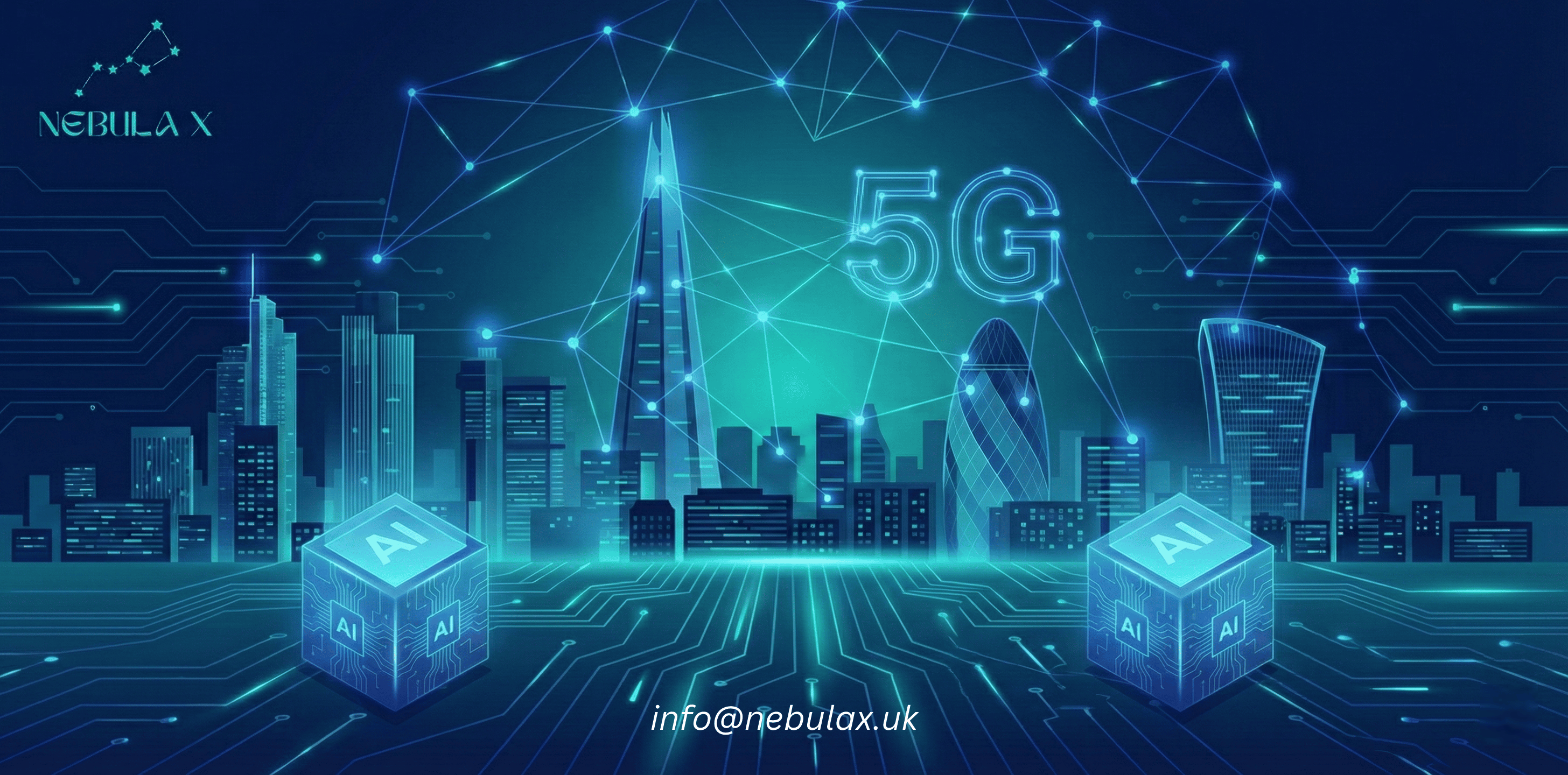
Currently, 5G is deemed as the standard tech which facilitates great digital transformation by allowing huge speeds, ultra-low latency, and connectivity for a huge number of devices. In 2025 the full power of data processing at the edge, i.e., closer to the source, will be the main factor driving the desire for the move from the traditional route of sending data to the centralized cloud. This mix-up of tech allows industries to realize instant data processing for IoT devices and smart factories, enhance video conferencing and AI-driven economization, and create brand new services. The £8 billion investment commitment from the UK government in digital infrastructure by 2025 clearly indicates the important role these technologies will have in the UK market.
This write-up will delve into the significance of 5G and edge computing for the startups in the UK, their relevance, and the methods of creating a win-win scenario for growth. Additionally, you will come across a concise case study and a well-chosen set of high-impact SEO keywords to boost your content ranking.
What Are 5G and Edge Computing?
5G is the 5th generation in mobile networks. It provides up to 100 times faster peak data rates than 4G, ultra-low latency (as low as 1 millisecond for response), and the capability to connect millions of devices at the same time.
Edge computing moves data processing away from central data centres and closer to where data is generated—be that a smartphone, a vehicle sensor or a factory robot. Instead of sending information across the internet to a distant cloud for analysis, edge computing uses local servers or gateways to process data on site. This reduces latency, decreases bandwidth costs and improves data privacy. This capability enables even the most data-intensive applications like augmented reality (AR), virtual reality (VR), self-driving cars and the internet of things (IoT) devices to be supported.
The union of 5G and edge computing results in a very potent platform. Data is delivered very quickly by faster connectivity while local processing gives very rapid insights and responses. Smart and efficient operations are made possible for businesses by the two technologies combined.
Who Should Be Interested?
Real-time data processing
With 5G and edge computing interconnected, businesses will have the chance to process data instantly. Datagraphic's 2025 digital transformation report cites real-time data processing enabled by 5G and edge computing in relation to IoT devices, smart factories, and autonomous vehicles. This translates to instantaneous adjustments of production lines according to the readings from sensors, delivery services that can change route for vehicles concurrently, and healthcare devices that are always monitoring patients without any lag.
Reduced latency and enhanced performance
The delay referred to as latency, which is the time taken from sending a request to receiving a response, is significantly reduced with the help of 5G. The same report highlights that the decrease in latency benefits video conferencing, AI-powered automation, and cloud gaming. This lucidity is very important for startups that are focusing on developing interactive experiences or providing critical services.
Increased protection and private networks
The firms that opt for a private 5G network will reap the rewards of having strengthened security and higher performance. The edge computing technology is also a factor in making it possible to keep sensitive data in-house, thus minimizing the risk of cyber threats associated with the internet. Considering that cybersecurity is one of the major concerns in the UK, these technologies provide a strong solution to guarantee customer data security.
Government backing and infrastructure investment
The United Kingdom government will be allocating a large sum of £8 billion for digital infrastructure throughout the next few years, that is until the year 2025, to completely renew public services and to help businesses in their digital moves. The whole thought is to create a welcoming place for new companies to come in to play around with 5G and edge technology.
Increase in demand for immersive experiences
The CDP Institute points out that extended reality (AR/VR) is the big surprise up rising sector in the UK market as it will have an increase of 31.7% in revenue by the year 2025. Thanks to 5G and edge computing it is now possible to bring these applications to the whole market.
Startups’ Plus Points of 5G and Edge Computing
-
Real-time analytics – Instant processing of sensor data to make prompt decisions, thus providing an increase in operational efficiency.
-
Improved customers’ experience – With nearly no time delay, customers can be provided with live tracking, AR shopping or instant support.
-
Cost cutting – Costs regarding bandwidth and cloud storage can be reduced through local data processing.
-
Larger scalability – Millions of devices can be connected without the problem of network congestion.
-
Better security – Keep sensitive data close to its origin and use private networks for security.
-
Market differentiation – Take in the latest technology first and be noticed in the already full market.
Use Cases for UK Startups
Logistics and delivery
Logistics companies will have the ability to install IoT sensors in vehicles that will transmit the real‑time data over 5G to edge servers situated locally. Smart routing will make delivery routes change quickly depending on traffic, weather and demand, thus lowering fuel costs and emissions. This scenario is consistent with the logistics optimization mentioned in the reports on the UK business trends.
Manufacturing and smart factories
Production facilities have the option to set up edge devices on their production lines to keep an eye on the health of machines and the quality of products. With 5G network, the connection between machines is very fast, and they can instantly respond. Predictive maintenance prolongs the life of machines and saves power, while the capacity of the processes is already set to the optimum level, so the human factor is taken away.
Healthcare and remote monitoring
Wirelessly connected gadgets are capable of taking patient information and sending it through 5G to the nearest data handling point. The professionals in the medical field are able to have real-time assessments, thus they can perform interventions when needed. The very short time between data being sent and received guarantees that life-critical data (like heart rate and oxygen in the blood) is always monitored promptly.
Retail and customer engagement
Retailers are in a position to allow customers to participate in lifelike AR via their stores or on the internet. The 5G connection provides for the visualization of products in high-definition, while edge computing deals with the technical graphics and customer's data right at the site. AI software can detect and analyze customer movements in the store and change the layout accordingly.
Agriculture and environmental monitoring
New businesses in agritech can put sensors in every corner of their fields to check on soil moisture, crop health, and climate conditions. Edge devices not only analyze the data at the site but also automatically send out the commands for irrigation or fertilization, while the 5G network secures instant communication.
Case Study: SmartFleet Logistics (Fictional Example)
SmartFleet Logistics is a hypothetical startup in the UK that takes care of the last mile deliveries for small e-commerce brands in the city of Manchester. The company had to deal with the problems of high fuel costs, late deliveries, and no transparency for the customers. One of the solutions SmartFleet came up with was the installation of a fleet management system that is powered by 5G and is capable of providing real-time monitoring of the entire operation.
All the vans had IoT sensors that were linked to the edge gateway at SmartFleet's depot. The moment the driver took off for a delivery, the system made use of live traffic data, weather conditions and delivery windows through 5G. The optimized route was automatically updated and the fleet drivers were informed through a mobile app. The data related to the car's performance and the driver's behaviour was handled at the edge, thus giving instant feedback. Customers were able to monitor their packages through an AI-powered chatbot on the company's website.
At the end of six months, SmartFleet reported savings of 30 % on fuel, delivered the products 20 % faster and customer satisfaction was substantially better. Besides, the company reduced its expenses on bandwidth by keeping the data close to the source and sending only the aggregated information to the cloud. Although this scenario is not real, it still highlights the substantial and immediate benefits that 5G and edge computing can provide to UK startups.
Issues and Factors
Despite the very strong advantages, there are also some difficulties waiting for startups to solve:
-
Infrastructure availability – Urban areas are quickly becoming the only places with full 5G coverage but still some regions are left without it. It's wise for companies to check the area’s coverage before taking up a 5G-based strategy.
-
Upfront costs – The construction of edge infrastructure and private 5G networks entails a significant monetary investment. Yet, the companies may recover these investments in the long run by using the efficiency gained.
-
Cybersecurity and compliance – The local data processing does lower the risks associated with it somewhat, but at the same time, it makes the data more susceptible to other kinds of threats. Startups will have to invest heavily in security systems including Zero Trust frameworks and AI-driven threat detection, which experts refer to as being crucial for business resilience.
-
Skills gap – The demand for digital skills in AI, cybersecurity and data analytics is still on the upswing. Startups might have to resort to training or partnerships in order to reap the full benefits of these technologies.
How Nebula X Can Help
We at Nebula X, focus on creating applications for startups and SMEs that are powered by AI, cloud-native and 5G-ready. Our range of services includes:
-
Solutions enabled by 5G & edge – We conceive and develop the web and mobile platforms that utilize the real-time information for the purposes of enhancing operations and customer experiences.
-
IoT integration customized – We provide assistance to the firms in the whole process of demand for the connected devices starting from the selection of the sensors up to and including the analytical dashboards.
-
Automation driven by AI – We add to the power of the workflows predictive analytics, chatbots and hyper-automation.
-
Designing for security – The solutions that we provide conform to the zero-trust model and also employ AI-based threat detection to secure your information.
No matter if you are a logistics company, a health-tech innovator or a retailer of next generation, our team can assist you in navigating through the 5G and edge computing ecosystem. Just reach out to discuss your project.
Contact us: info@nebulax.uk


 Blockchain
Please log in to post a comment.